The Modern Auto Repair Marketing Framework
By Melissa 'Birdie' Patterson
A clear way to understand what works, why it works, and where effort belongs
I recently had a conversation with a marketing coach who has been around this industry a long time. The kind of guy who has seen radio work, has seen newspaper ads work, and has seen shops grow for decades without ever worrying about Google, reviews, or social media.
At one point he said, “If I were a shop owner today, I would probably just stick with radio and a simple one page website. You know, KISS. That is what people understand.” I did not disagree with him. But I did not fully agree either. Because here is the part that gets missed in a lot of these conversations. Marketing did not stop working the old ways. Those ways just stopped working alone.
Nothing disappeared. Everything stacked. Radio still has value. So does word of mouth. So does being known in your town. But now those things sit alongside Google searches, online reviews, photos, videos, and the quiet ways customers check you out before they ever call or walk in. That layering is what makes marketing feel confusing and heavier than it used to. And it is why so many shop owners feel stretched, unsure where to focus, and frustrated when advice conflicts.
This framework is meant to change that. Not by telling you what to buy or what to chase, but by helping you understand how modern auto repair marketing actually works. By the end of this, you should be able to see why marketing feels heavier, understand what each type of marketing is responsible for, and make calmer, more intentional decisions about where your effort belongs.
Before getting into what to focus on now, it helps to understand how we got here. Not in a nostalgic way, and not to say things were better back then, but to see how marketing actually evolved over time. When you step back and look at it decade by decade, the confusion starts to make sense.
Here is where we start.
How Auto Repair Marketing Changed: 1975 to 2026
One of the biggest reasons marketing feels harder today is because most people are trying to evaluate it using an old measuring stick. For a long time, marketing lived in a fairly simple world. There were fewer places customers looked and fewer signals they relied on to make a decision. If you showed up consistently in the places that mattered back then, it worked.
That does not mean those methods were better. It just means the environment was lighter. What changed is not that marketing stopped working. What changed is that it layered. Nothing disappeared. Everything began to stack.
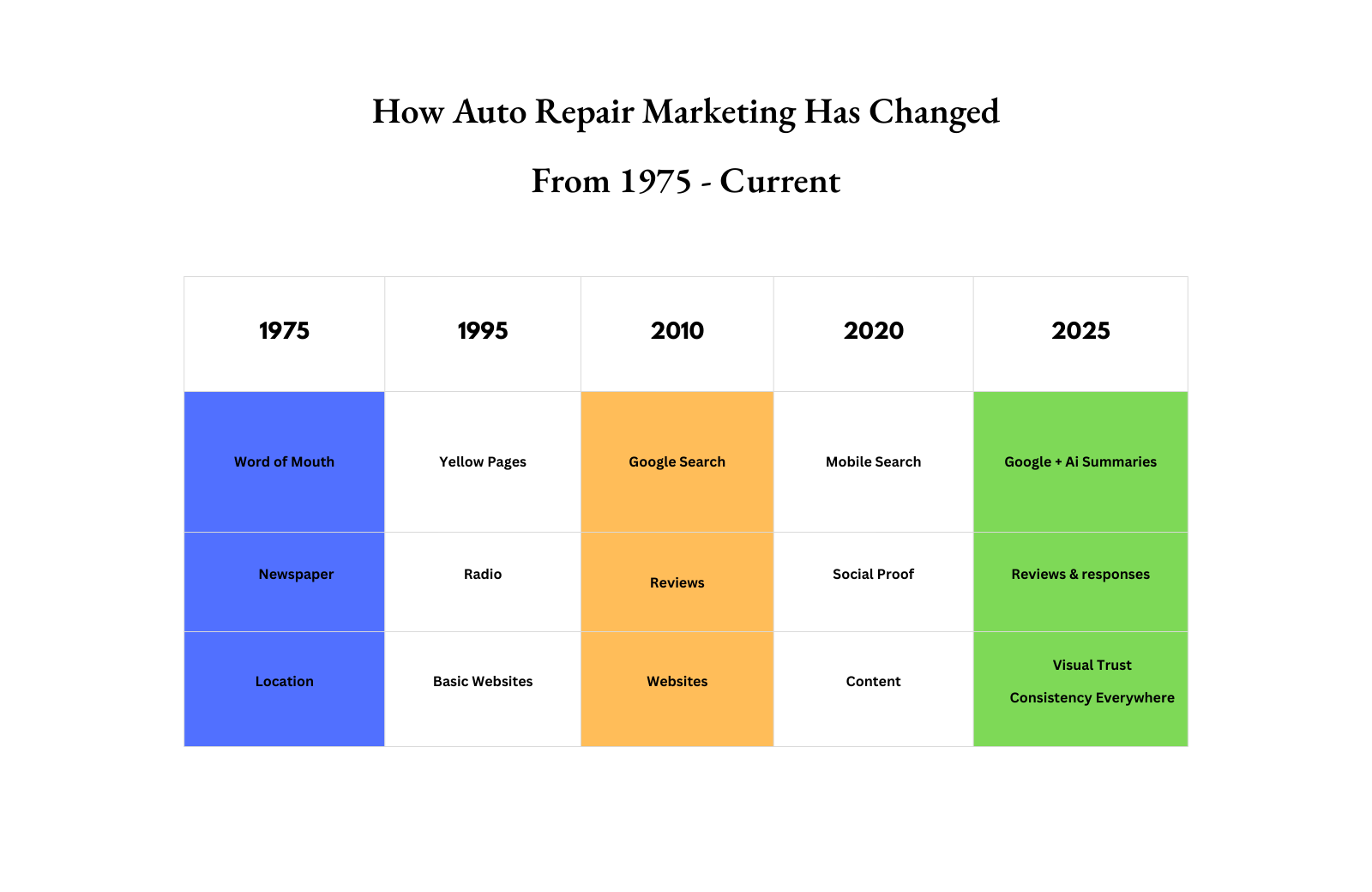
In the 1970s, marketing was largely local and personal. Word of mouth carried enormous weight. Your physical location mattered. A recommendation from a neighbor or a trusted mechanic down the street was often enough for someone to make a decision.
By the mid 1990s, new layers were added. Yellow Pages became a major reference point. Radio started playing a stronger role. Early websites showed up, not as decision makers, but as credibility markers. You did not need much, just proof that you existed.
As search engines grew in the 2000s and early 2010s, another layer was added. Google became the starting point. Reviews entered the picture. Websites were no longer optional, they became part of how customers compared one shop to another.
Then came mobile search. People were no longer researching at home on a desktop. They were standing in parking lots, sitting in waiting rooms, or pulled over on the side of the road. Social proof started to matter more. Content, photos, and visible activity became part of how trust was built.
Then came mobile search. People were no longer researching at home on a desktop. They were standing in parking lots, sitting in waiting rooms, or pulled over on the side of the road. Social proof started to matter more. Content, photos, and visible activity became part of how trust was built.
And now, we are entering the next layer.
Search still matters. Reviews still matter. But now AI summaries are pulling from reviews, websites, photos, community conversations, and consistency across platforms to form an opinion on behalf of the customer. That opinion is often formed before a shop ever knows the customer was looking. This does not mean marketing changed overnight. It means more signals are being gathered quietly, and faster.
Marketing Relevance Over Time: 1975 to 2026
- 1975 focused on word of mouth, newspaper, and physical location.
- 1995 added Yellow Pages, radio, and early websites.
- 2010 layered in Google search, reviews, and stronger website expectations.
- 2020 expanded into mobile search, social proof, and content.
- 2025 now includes Google plus Ai summaries, reviews with responses, visual trust, and consistency everywhere.
When you see it laid out this way, something important begins to click. Marketing did not get worse. It did get heavier because it got layered. Each decade added another place customers look. Another question they quietly ask. Another signal they use to decide whether a shop feels trustworthy and current. That is why marketing feels more complex today. Not because you are doing it wrong. Not because the old ways stopped working. But because they no longer work by themselves.
Once that reality is understood, the pressure eases. The goal stops being to target all of them, and starts being to understand what role each piece plays. This understanding is what makes the rest of this framework useful.
Not All Marketing Does the Same Job
One of the most common frustrations I hear from shop owners is that marketing feels intangible. They cannot quite grab hold of it and make it “work.” Something works for a while, then it does not. One effort brings calls, another seems invisible, and it becomes hard to tell what to keep, what to fix, or what to stop.
A big part of that frustration comes from expecting every piece of marketing to do the same job. It does not. Every marketing effort serves a different purpose. When those roles are clear, results make sense. When they are not, it feels inconsistent and disappointing.
This is where clarity starts to replace pressure.
Leave a Comment
Your email address will not be published.